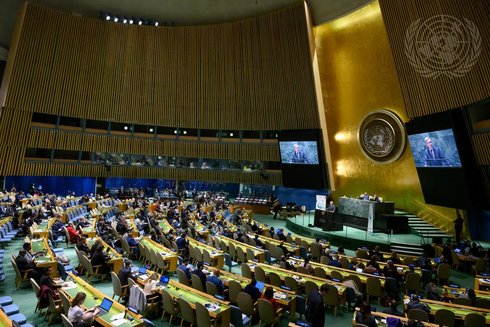
Politique Internationale — Has the UN had its day? Should it be abolished, and if so, what should replace it?
Marie Heuzé — Certainly not abolish it, but strengthen it. It is indispensable to address the breakdown of international relations that has been going on since Russia’s invasion of Ukraine in 2022 and in the face of Donald Trump’s voracious appetite for power and territory since 2025.
Over the past years, the UN has survived numerous crises, wars, and armed conflicts on every continent. It has supported decolonisation and independence movements. Its member states—193 today—still hold out hope for world peace, for collaboration among nations to advance their peoples and uphold their fundamental rights; and this, even though the Organization does not have all the means to achieve this noble goal.
Does this mean we should abolish the UN, to which 193 countries have acceded, adopted its Charter, and signed the Universal Declaration of Human Rights? Once again, I do not think so. In any case, it is certainly not the Board of Peace launched by Donald Trump in January 2026 at the Davos Forum to compete with the UN that will be able to replace it! Moreover, he has acknowledged this himself. Only twenty-two countries have joined this Board, which will operate on a transactional model, exchanging “peace services” for financial or territorial returns on investment for its members. The entry fee set by Donald Trump to become a permanent member is one billion dollars. It’s hard to believe…
P. I. — What are the specific causes behind the UN’s powerlessness, or even its uselessness?
M. H. — The main cause lies in the composition of the Security Council and the divergent interests of its five permanent members. From 1945 to 1985, the East-West divide dominated its decisions and mediations, paralysing its diplomatic efforts. With few exceptions, it was unable to function as a genuine instrument of international negotiation.
After the fall of the Berlin Wall and the collapse of the communist regime, one might have expected cooperation among the five permanent members of the Security Council. Hopes for agreements on sensitive issues were dashed. Admittedly, UN-mandated peacekeeping operations increased with their agreement. But they recorded more failures than successes in Angola, Somalia, Yugoslavia, Rwanda, the Congo, and South Sudan.
In 2003, the United States led a military intervention in Iraq with the support of the United Kingdom but without a UN mandate. Kofi Annan had deeply angered Washington by declaring the operation “illegal” because it had not received the Security Council’s approval. Ten years later, he admitted in an interview with Time, regarding his tenure: “My darkest moment was the war in Iraq, and the fact that we were unable to prevent it.” A sentiment shared by all UN officials in New York.
Russia annexed Crimea in 2014 and then invaded Ukraine in 2022. Four years later, Vladimir Putin still refuses to withdraw his troops and is demanding new territories …
This website is freely accessible. To continue reading, you need to register an account.
I already have an account
I create my account
This will be your personal account where you could consult anytime :
- Order history
- Links to purchased magazines, articles, or interviews
- Personal informations