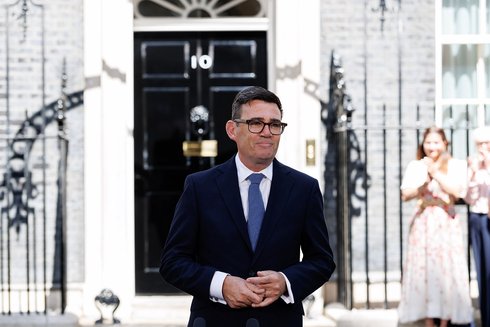
Behind every political figure, there is a search for an inheritance, a lineage, a political tradition. Britain’s new prime minister is no exception. Yet it is difficult to know exactly where to place him, and his political family is a mixed one. Andy Burnham could be seen as the natural offspring of Tony Blair and Jeremy Corbyn, a synthesis of New Labour and a more interventionist strand of the Labour left. He is positioned further to the left than his predecessor, Keir Starmer, while being nowhere near as “red” as Corbyn. Burnham himself describes his politics as “pro-business socialism.”
Because Andy Burnham has revealed relatively little of himself — he did not have to campaign for the job, but instead benefited from a lightning-fast coup — his first steps in office are being closely watched. In his first appearance before the House of Commons, as Parliament returned on September 1, the new prime minister lamented Britain’s “decline.” Burnham may feel that he has finally reached the place he has dreamed of for three decades, but he believes that “Britain is not where it should be.” He identifies two culprits: Margaret Thatcher and Brexit.
“Since the 1980s, this country has taken a series of wrong turns: political power was centralized, economic power was privatized, the country was deindustrialized. Then came Brexit,” the new occupant of Downing Street said.
Unlike his ill-fated predecessor, however, Andy Burnham is careful not to dwell too heavily on gloom. When Keir Starmer came to power two years earlier, he had promised little more than blood, sweat and tears. His assessment of the state of the United Kingdom was certainly clear-eyed, and his rhetoric largely free of demagoguery. But his constant emphasis on the state in which the Conservatives had left the country, rather than on any positive vision, eventually demoralized both the British public and the business community. Everything seemed weighed down, difficult, doomed to failure. Later attempts to correct this bleak narrative proved ineffective. Burnham, by contrast, has avoided the pessimistic trap. It is possible to give people “hope,” he insists.
To set the tone, following his appointment in July, Burnham embarked on a summer tour across the country. A much better communicator than Starmer, he launched a major “listening tour,” designed to reconnect with an electorate from which Labour has drifted away.
“This month, I’m leaving Westminster and coming to your towns. Not for the photo opportunities, but because I want to hear directly from people in their communities,” he wrote in an article before setting off.
Again and again, the man from the North denounces the divide between London and the rest of the country. Westminster, he argues, has become a symbol of a distant political establishment disconnected from people’s everyday realities. He wants to bridge that gap. Highly active on social media, particularly TikTok, he has cultivated an easy-going image as a leader who is close to the ground — drinking a pint at the pub with his ministers or playing guitar with Ukrainian soldiers in Kyiv. His critics see this as mere PR, even easy populism. Burnham claims that he is trying to establish a different way of doing politics.
The Man from the North
To lend credibility to his message, Burnham plays heavily on his roots in “real England.” A longtime MP, he left Westminster nearly a decade ago to become mayor of Greater Manchester. Since then, he has run England’s second city and its surrounding region, home to 2.8 million people. The 56-year-old intends to draw his legitimacy from this experience on the ground. His allies are keen to stress that, although he served as a minister several times, he is not one of those “out-of-touch” London elites. And that when he talks about the concerns of ordinary Britons, he knows what he is talking about.
Back in 2016, the year of the Brexit referendum, he was already warning that Labour was “becoming disconnected from the North” of England.
Andy Burnham is a child of these regions, with their industrial and mining past. Born in a small town north of Liverpool, the son of a telecommunications technician and a medical receptionist, he attended a Catholic school before going on to Cambridge. It was a passage through one of the institutions that form England’s elite. He is fond of recalling that he joined Labour at the age of 14, having been “politicized” by the great miners’ strike of 1984–85, which was crushed by Margaret Thatcher’s Conservative government.
He first worked on parliamentary assignments dealing with issues as varied as the National Health Service and football. He then became an adviser to the Culture Secretary. His political career properly began in 2001, when he was elected MP for Leigh, on the outskirts of Manchester.
He subsequently joined Tony Blair’s government, and then that of Gordon Brown. He successively served as a junior Home Office minister, Chief Secretary to the Treasury, Culture Secretary and Health Secretary. In the latter role, he opposed any further privatization of NHS services, at a time when some functions had been opened up to competition and private providers. When the Conservatives returned Labour to opposition, he held various positions in the party’s shadow cabinet.
The Manchester Laboratory
In 2017, he resigned his seat in Parliament to run for mayor of Greater Manchester, and won. He was subsequently re-elected in 2021 and 2024, each time by a wide margin. He has managed the former world capital of cotton relatively well. After a long period of post-industrial decline, the city has enjoyed economic growth over the past few years at twice the national average.
He earned his nickname, the “King of the North,” during the Covid crisis, after fighting for more funding to support businesses and workers in the region. He is so attached to his political stronghold that he has a worker bee, the symbol of Manchester, tattooed on his arm.
From this experience in the northern metropolis, Burnham has developed a political doctrine. “Manchesterism” seeks to combine a dynamic economy with greater government intervention. It also calls for more power to be devolved to local authorities, rather than having everything decided from Westminster and London.
This includes taking back control of certain essential services. Burnham points to the improvement of public transport in Manchester as an example: buses, trams and trains have been integrated into a locally controlled regional transport system known as the “Bee Network.”
Similarly, public investment should be used to stimulate growth. Investment in transport, housing, infrastructure and reindustrialization, he argues, will create a more productive economy in the regions instead of concentrating ever more activity in London.
Although he advocates a greater role for the state, Burnham also presents himself as business-friendly — hence his famous “pro-business socialism.” He wants to restore power and deliver growth “in every postcode” across the country. Manchester is the laboratory for what he wants to achieve nationally.
Winning Back the Working Classes
Positioned further to the left than Starmer, despite once being labeled a “Blairite,” Burnham repeatedly stressed during the by-election campaign that brought him back to Westminster that every vote for him was “a vote to change Labour.” He promised to put the party “firmly back on the side of working people.”
Earlier this year, he described to The Guardian “the four horsemen of the British Apocalypse”: deregulation, privatization, austerity and Brexit.
As soon as he arrived at Downing Street, he sought to give substance to that promise by announcing a series of measures aimed at “putting money back in people’s pockets.” These included scrapping VAT on household electricity and capping bus fares at £2. Hardly enough to revolutionize the lives of Britons, but a way of staking out political territory.
Other decisions, such as accelerating a £10 billion affordable housing program, will only produce results over the longer term. Burnham is also considering gradually bringing water, energy and transport back under public control.
Tackling the cost-of-living crisis is one of his main challenges. He advocates a form of industrial patriotism, particularly in strategic sectors. And he wants British companies to be best placed to win public contracts.
Beyond this, the new prime minister says he has a broader and more ambitious goal in mind. When he promises “the deepest changes in 40 years,” he is referring to his grand project of decentralization.
He wants to undertake “the biggest transfer of power this country has ever seen.” His motto is “growth through devolution.” The “King of the North” is convinced that Britain’s economic stagnation is rooted in the fact that the country is “one of the most centralized in the world.”
Under the excessive control of Westminster and Whitehall — the British Parliament and the ministries that embody London’s political power — the system, he argues, does not work for working people.
The centralization of power in England has long been the subject of debate. It is indeed greater than in many other European countries. Scotland, Wales and Northern Ireland have devolved parliaments, but England does not, even though it is home to more than four out of every five Britons.
Local authorities have relatively limited powers: many decisions concerning education, healthcare, transport and national taxation are made by the government and Parliament in London. The Treasury also imposes economic assessment rules on public investment. As a result, local projects are often dependent on demonstrating a favorable cost-benefit ratio. This policy is criticized by those who argue that it favors already prosperous areas, where investment can generate higher returns than in disadvantaged regions.
Politically, Burnham’s message undoubtedly resonates in the “left-behind” regions, where growing numbers of voters are turning to Nigel Farage’s Reform UK. The ambition to tackle a structural problem is understandable. But is it a magic bullet for the country’s longstanding struggle to raise productivity?
Will this “radical localism,” as the Financial Times calls it, be enough to pull Britain out of its prolonged economic stagnation? That remains doubtful.
The announcement of a “No. 10 North” — a northern version of 10 Downing Street — has prompted some skepticism among those who see it as a communications stunt with little substance. Burnham wants to move part of the Downing Street operation to Manchester in order to coordinate this major program of devolution.
The risk is that this will simply reproduce previous governments’ unsuccessful attempts to “rebalance” regional economies. Many observers have noted the striking resemblance to former Conservative prime minister Boris Johnson’s “Levelling Up” program.
Whatever the case, such a “revolution” is a long-term undertaking, while the British economy urgently needs a boost. On this front, Andy Burnham’s vision remains largely untested. Before moving into Downing Street, he had appeared inclined to increase spending. He now faces the hard wall of fiscal reality, with the Treasury working to rein in his ambitions.
John Healey and Economic Realism
To reassure both the markets and himself, Burnham appointed a Labour veteran, John Healey, as Chancellor of the Exchequer. The two men know each other well. Referring to his neighbor in Downing Street — Healey occupies No. 11 — the new Chancellor does not call him “the prime minister,” but simply “Burnham,” a sign of their longstanding familiarity.
They served together in Tony Blair’s government more than twenty years ago and became friends. Healey’s appointment surprised everyone, as political London and the press had been buzzing about other possible names.
Yet he already has considerable experience in the field. In 1999, he was an aide to Gordon Brown when Brown was Chancellor, before holding senior positions at the Treasury between 2002 and 2008.
To reassure the financial sector further, Andy Burnham asked three prominent economists to work on his program: former Bank of England chief economist Andy Haldane; former head of the Office for Budget Responsibility, the body responsible for assessing government economic policy, Richard Hughes; and former Goldman Sachs economist Jim O’Neill.
In his first major speech, in early September, the new Chancellor pledged to make Britain “growth Britain” again. But he remained fairly vague about how he intended to achieve this. His main focus was on reassuring the markets.
While the private sector fears that Burnham’s plans could prove costly for the country, John Healey stressed “the need to control public spending.” Some observers even joked that his plea for “strict fiscal discipline” could have come straight from the mouth of his predecessor, former Chancellor Rachel Reeves.
Clearly, this is not the moment for revolution, and John Healey is emphasizing continuity. He has pledged that Labour will honor the “very firm, very clear and very precise” commitments made in its 2024 manifesto.
Labour promised not to raise income tax, national insurance contributions or VAT. But whether it is social housing, bringing essential services back under public control, or tax cuts for the poorest, Burnham’s plans risk pushing up spending.
Many figures in business and finance are therefore preparing for what they fear most: higher taxes to fill a budget deficit made worse both by these projects and by rising borrowing costs on the market, now the highest in the G7.
Pressed on the issue, John Healey refused to rule out further tax increases, without speculating on which ones. With income tax apparently off the table, the options could include taxes on banks, capital gains, oil companies, inheritances or gambling machines.
The executive’s room for maneuver is narrow, and such increases appear difficult to avoid. Burnham himself has pointed out that there is “some headroom” in Labour’s program.
He will also have to tackle soaring welfare spending, but without cutting too deeply. Starmer had triggered a revolt on the party’s left by seeking to reduce benefits for pensioners and disabled people.
Ironically, John Healey himself finds himself in a politically awkward position. Last June, he dramatically resigned as Defence Secretary in Starmer’s government. Healey accused the former prime minister of putting the country at risk by underfunding the armed forces.
He had failed to persuade the Treasury to devote 3% of GDP to defense by 2030. The then Chancellor, Rachel Reeves, had objected that this would increase military spending by around £10 billion a year by 2030.
Healey now finds himself in the difficult position of arbitrator. He has promised to present a “road map” next year for reaching NATO’s target of spending 3.5% of GDP on defense by 2035.
Many Labour MPs are wondering where he will find the necessary funds. The path ahead looks narrow and perilous. The moment of truth will come when the budget is unveiled at the end of October.
A Tougher Line on Immigration
Andy Burnham is also facing pressure on another major concern among British voters: immigration.
The anti-immigration riots that periodically flare up across the country, as well as opinion polls, show how acute the issue has become. According to an Ipsos study, more than two-thirds of Britons believe immigration is too high. Another YouGov poll found that 70% consider immigration to have been excessive over the past decade.
And although net migration fell by almost half in 2025, as a result of measures introduced by previous Conservative governments, a poll by the think tank British Future found that half of Britons believe immigration has continued to rise and expect another increase.
Brexit did nothing to solve the problem. If anything, it made matters worse — at least initially. The phenomenon dubbed the “Boriswave,” the surge in migration that followed Britain’s departure from the EU under Boris Johnson, is evidence of this.
Between 2021 and 2024, around 4.2 million people entered the country, and more than a quarter of them stayed. This happened even though one of the Brexit campaigners’ major promises was to “take back control” of the borders.
What is more, European migrants were replaced by migrants from the Middle East, Asia and Africa, many of them Muslims, according to critics on the right of the Conservative Party.
This wave of migration deeply irritated “peripheral England,” particularly the North and the Midlands, pushing many voters into Nigel Farage’s camp.
The “King of the North” is well placed to understand how deeply the issue concerns voters. In his “Brexit-voting” heartlands, opposition to mass immigration is a powerful driver of voting behavior.
As mayor of Greater Manchester, Burnham repeatedly highlighted the impact of immigration on post-industrial towns and cities in the North and the Midlands.
During the Makerfield by-election that enabled him to return to Westminster, Burnham toughened his rhetoric on the issue. He argued that immigration detention should be used more extensively in order to deport migrants with no legal basis for remaining in the country more quickly.
Without setting specific targets, he repeatedly insisted that net migration “must come down further.”
The new prime minister is attempting to walk a tightrope that Starmer failed to navigate. He is seeking a compromise capable of satisfying both those calling for stronger borders, particularly in central and northern England, and Labour’s liberal urban electorate.
In July, a week before entering Downing Street, Burnham backed controversial changes introduced by Home Secretary Shabana Mahmood to immigration policy.
Mahmood, regarded as one of Labour’s hardliners on the issue, unveiled far-reaching reforms tightening asylum rules and the conditions under which people arriving in Britain on work visas can obtain permanent residency.
Among the measures is a new “temporary” refugee status, which can be revoked once individuals are no longer considered at risk in their country of origin.
Asylum seekers will also be required to contribute to the cost of their accommodation and support as soon as they are able to do so, with the aim of reducing reliance on hotels.
Finally, the legislation would restrict the way judges can interpret Article 8 of the European Convention on Human Rights, preventing irregular migrants from invoking it to avoid deportation on the grounds that removal would interfere with their right to family life.
Andy Burnham voted in favor of the legislation in Parliament. At the same time, however, he promised an asylum system that would be “both humane and credible.”
He is under pressure from dozens of Labour MPs who have urged him to soften some of the measures in the Mahmood bill, including the doubling of the period required to obtain permanent residency — a status granting the right to live, work and study permanently in Britain — from five to ten, or even fifteen, years.
EU, Ukraine, the Middle East, Trump… the “Little Guy from Northern England” Takes on the World
Highly focused on domestic issues, Andy Burnham has prompted a degree of skepticism when it comes to foreign policy. International affairs do not seem to be the natural territory of the “guy from Northern England”: Manchester before Beijing or Tehran, an English version of “Corrèze before the Zambezi.”
Offering some advice from experience, former Conservative prime minister Rishi Sunak warned the new occupant of Downing Street about the demands of international affairs and national security.
Keir Starmer also warned him that it would be difficult to spend less time on foreign affairs than he himself had.
On a number of issues, notably Ukraine and relations with the EU, considerable continuity with Keir Starmer’s foreign policy is likely.
On Ukraine, an issue that commands broad consensus across the British political class, Andy Burnham has pledged to provide Kyiv with “100%” the same support as his predecessor.
To prove wrong those who regard him as too inward-looking, he traveled to Ukraine in late August, where he signed significant agreements.
The first concerns the use of artificial intelligence by the armed forces. The partnership will combine Ukraine’s unique operational experience with Britain’s AI ecosystem.
The second gives Kyiv access to classified information on components of the Franco-British Storm Shadow cruise missile, enabling Ukrainians to manufacture them locally. Supplied to Ukraine since 2023, these missiles have been used to strike targets in Russia.
On Europe, Andy Burnham wants to go further and faster. Before entering Downing Street, he had said he wanted to “build on the progress made in negotiations between the United Kingdom and the European Union.” Since then, he has advocated a more ambitious rapprochement. But with Nigel Farage on the rise, the man who voted against Brexit has remained cautious. Before the summer, he said he respected the decision taken in the 2016 referendum and would not propose that Britain rejoin the EU — even though he hoped to see such a return “in my lifetime.”
The new prime minister therefore intends to respect the “red lines” inherited from Labour’s program: no return to the single market or customs union, and no restoration of free movement. Instead, he wants to pursue a pragmatic “reset” with the Europeans in areas where both sides have an interest in cooperating.
In practical terms, this means concluding a whole series of sector-specific agreements covering agriculture, standards, energy, defense, services and youth mobility, while gradually rejoining certain European mechanisms.
London and Brussels held their first bilateral summit in spring 2025, during which they agreed on a “new strategic partnership.”
This provides for closer cooperation on defense and security, as well as rapid, dynamic alignment by the United Kingdom with European sanitary and phytosanitary rules, in order to reduce barriers to food trade.
Since then, an agreement has also been reached for Britain to rejoin the European Erasmus exchange program from 2027, as well as to associate with the European Horizon research program and the Copernicus space program.
Negotiations have also begun on British participation in the European electricity market and association with the carbon market.
The United Kingdom is also interested in joining the EU’s SAFE program, a €150 billion lending mechanism designed to support joint procurement of military equipment.
But the initial talks broke down over a disagreement about the size of Britain’s financial contribution.
A new UK-EU bilateral summit is scheduled to take place before the end of the year. This rapprochement is not to the liking of all Brexit supporters, some of whom accuse the Labour government of trying to re-enter the EU through the back door.
It is in the Middle East that Andy Burnham has most clearly departed from Starmer. Under pressure from the party’s left wing, he has adopted a tougher line toward Israel.
In an interview with The Guardian over the summer, he said Labour had “fallen short” when the war in Gaza broke out by failing to call immediately for a ceasefire.
When Keir Starmer took over the party, he had set about ridding it of the antisemitism that had been allowed to take root under Jeremy Corbyn.
After October 7, he unequivocally condemned Hamas and affirmed Israel’s right to defend itself. Over the following months, however, he increasingly distanced himself from Israel and intensified his criticism of its response. But this was not enough to satisfy Labour’s left wing. It was on this issue that Andy Burnham made his first major foreign-policy move. On September 8, his Foreign Secretary, Ed Miliband, announced a package of sanctions targeting Israeli settlements in the West Bank. The measures — essentially symbolic in scope — will come into force within six to nine months, between March and June 2027. They include a ban on imports of products originating in settlements in the occupied territories, as well as measures targeting British companies that have commercial ties with those settlements.
Burnham insists that he distinguishes between Israel and the settlers, but the initiative nevertheless represents a dramatic deterioration in relations between the two countries. Ed Miliband accused the Israeli government of “turning a blind eye to ethnic cleansing” carried out by settlers in the West Bank. In retaliation, the Israeli authorities announced the closure of the British consulate in East Jerusalem.
In the short term, one of the new prime minister’s major challenges will be dealing with the unpredictable Donald Trump.
The US president had repeatedly attacked Keir Starmer, angered in particular by what he saw as Starmer’s insufficient support for his offensive against Iran. He also criticized him over what he described, among other things, as excessive leniency on immigration, restrictions on the “freedom of expression” of nationalist activists, and reluctance to restart North Sea drilling. In Trump’s world, the “special relationship” no longer seems quite so special.
Trump has already fired a few warning shots at the Burnham government, taking aim at British sovereignty. He suggested that he might “reconsider” the US position of neutrality on the Falkland Islands. He said he was “capable of resolving” any potential dispute over the territory, over which Britain and Argentina went to war in 1982, a conflict that left 649 Argentines and 255 Britons dead. Buenos Aires has continued to press its claim to the South Atlantic islands, located around 600 kilometers off the coast of Patagonia. Until now, the United States, like most Western countries, has recognized that Britain administers the islands de facto, without taking a position on sovereignty in the strict sense. Some observers believe the Trump administration is using the issue to pressure London into significantly increasing defense spending.
Ever outspoken on borders, Donald Trump has also said he would welcome a “united Ireland.” “That would be fantastic. It will happen,” he declared during a visit to Ireland, breaking with the neutral position the United States has traditionally maintained on the sensitive issue of Northern Ireland. Andy Burnham reiterated that position in the House of Commons: under the terms of the 1998 Good Friday Agreement, a referendum can be held if it appears likely that a majority of people in the province would vote for unification. London, drawing in particular on opinion polls, considers that this is not currently the case. During his first visit to Northern Ireland since taking office, in late August, Burnham ruled out holding a referendum in the short or medium term.
The Trump administration has also made clear that Burnham could pay a price for moving too close to the European Union. Jamieson Greer, the US Trade Representative, complained that Britain had chosen “Brussels over America,” arguing that it was failing to use the freedom created by Brexit to deepen ties with the United States. And, of course, to accept agricultural goods and other products produced according to American standards…
In Conclusion…
For now, Andy Burnham has skillfully opened the first chapter of his political story. Although communication and political messaging play a significant role in that story, he has to his credit the fact that he immediately tackled concerns among voters that his predecessor had failed to address.
Opinion polls suggest that the new prime minister has already improved the public image of his party. As a result, the proportion of voters explicitly seeking to vote against Labour has fallen sharply.
In spring 2026, 35% of voters wanted to “stop Labour”; that figure has now fallen to 20%.
With a general election scheduled for 2029, the new Labour leader has little time to win back the working-class voters who defected to Nigel Farage.
For months, Farage’s Reform UK had been leading the polls. By the end of summer 2026, however, it had slipped slightly, with some polls, such as YouGov’s, putting it neck and neck with Labour at 23% each, while others were now placing Labour ahead, at 27% or 28% against 25%.
Controversies surrounding Reform UK’s murky financing, which have dogged the party for several months, partly explain its loss of momentum or decline.
Whether it has hit a ceiling or merely reached a temporary plateau remains unclear.
The Conservatives, meanwhile, have staged a modest but genuine recovery in the polls, now hovering around 20%.
In early September, for the first time in a long while, a More in Common poll even put them ahead of Reform UK.
This has given the Conservatives renewed confidence and hope, prompting them to proclaim a “comeback” under Kemi Badenoch.
The Tory leader’s personal popularity has steadily increased in recent months. For now, she remains firmly opposed to an electoral pact with Reform UK in 2029.
The issue is nevertheless being debated within the Conservative Party, with some MPs arguing that the two parties should avoid standing against one another in certain constituencies in order to limit the splitting of the right-wing vote.
Nigel Farage, for his part, has not ruled out such arrangements. Yet he sees himself more as the new champion of the right and has preferred to “poach” a number of Conservative grandees.
Badenoch, meanwhile, intends to set the “seriousness” of her party against what she portrays as Reform UK’s “amateurism.”
For Andy Burnham, the honeymoon will inevitably come to an end. Running a country of 70 million people, with a £1 trillion economy, is another matter entirely from governing an urban area of 2.8 million. And after seven prime ministers in ten years, the British public has little patience left. They want action to match the words. The new occupant of No. 10 Downing Street has in mind the euphoric dawn of his predecessor — which quickly turned into a twilight of collapsing popularity.